
A coach's review of your last chess.com game.
Type your username, pick a game, and in a few minutes you get a review written for your level, every claim checked by the engine.
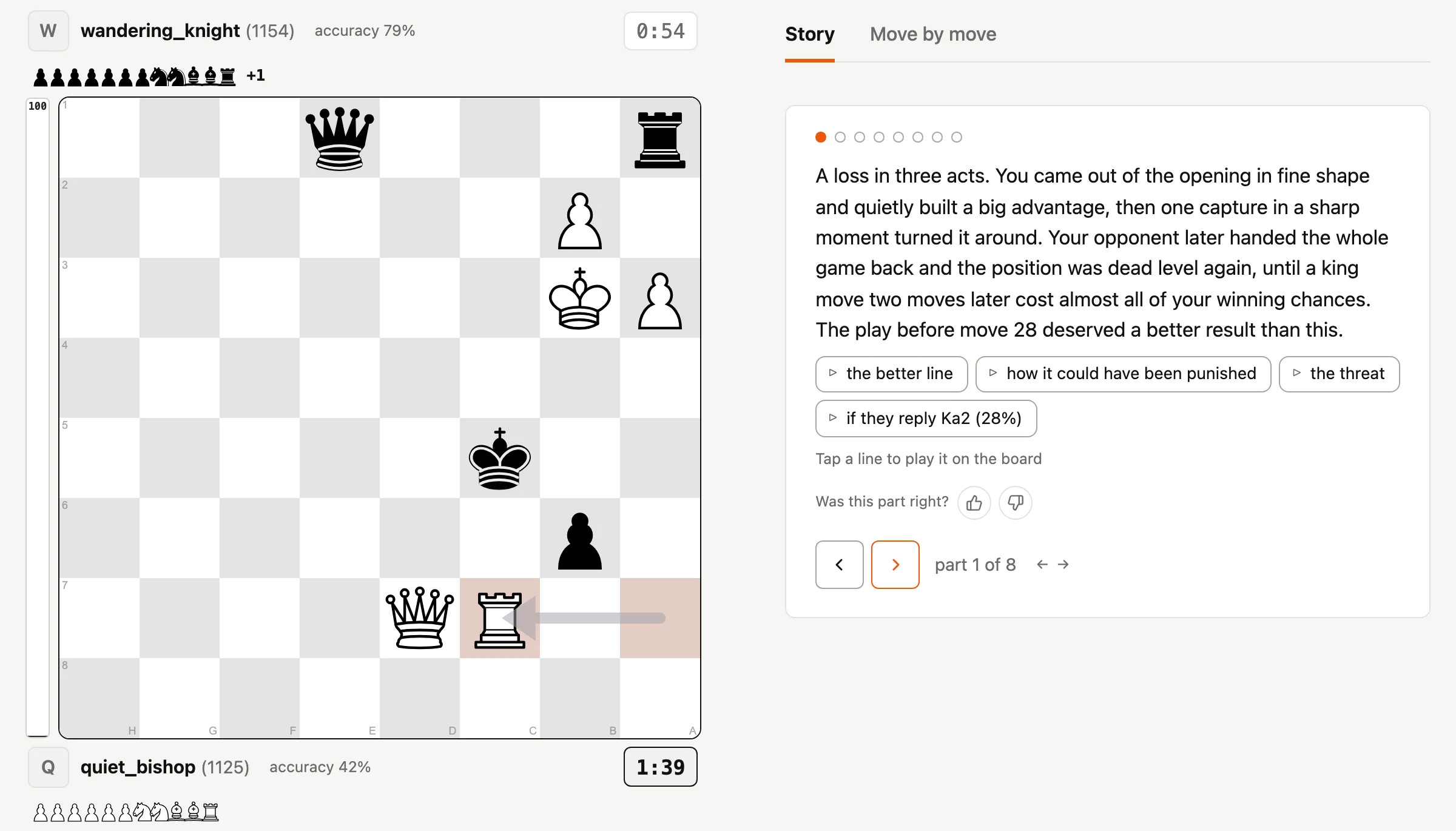
How it works
- 1
Type your username
Your last ten chess.com games appear, newest first. Nothing to connect, nothing to install: game history is public data.
- 2
Pick a game
stockfish goes through every move of it, usually in around a minute. No account, no card.
- 3
Read the review
The story of the game in parts, the moment that decided it, and what players at your rating find there. Then play the key lines out yourself.
“Only 15% of players at your rating find this move.”
Most tools grade you against the engine's best line, whether or not anyone at your level would find it. xraychess keeps the classic marks you know and adds a coach who grades against what players at your rating actually play. A move most of them miss is a lesson, not a scolding.
| a typical engine review | xraychess | |
|---|---|---|
| your moves graded against | the engine's best line | what players at your rating actually find |
| what gets flagged | every eval dip | the mistakes worth fixing at your level |
| the commentary | canned phrases, or none | checked against the analysis, or not shown |
| the key lines | watch the engine play | play them out yourself, against the engine or your level's real replies |
| what it takes | an account | a username |
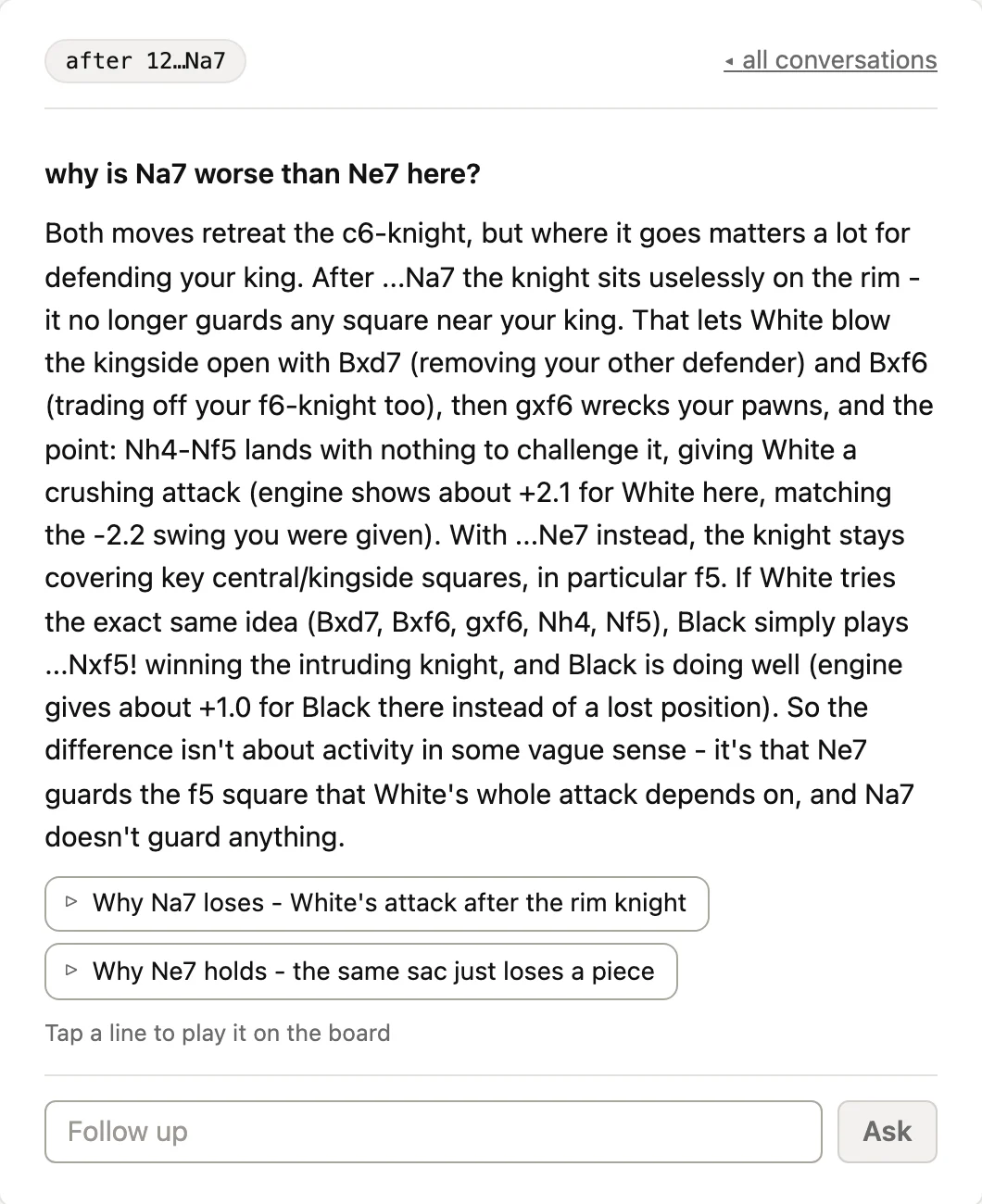
Ask about any position, and it investigates
Stop anywhere in the game and ask. The coach probes that position with the engine, plays the lines out on the board, and looks up what players at your rating actually do there. Every move, square and number in the answer has to trace back to that evidence, or the answer is not shown at all.
In the example, someone asks why one knight retreat is worse than the other. The answer follows White's attack to the one square it depends on, names the piece that guards it, and gives the engine's number for each line. Both lines can be played out on the board. Questions come with an account; reading a review doesn't need one.
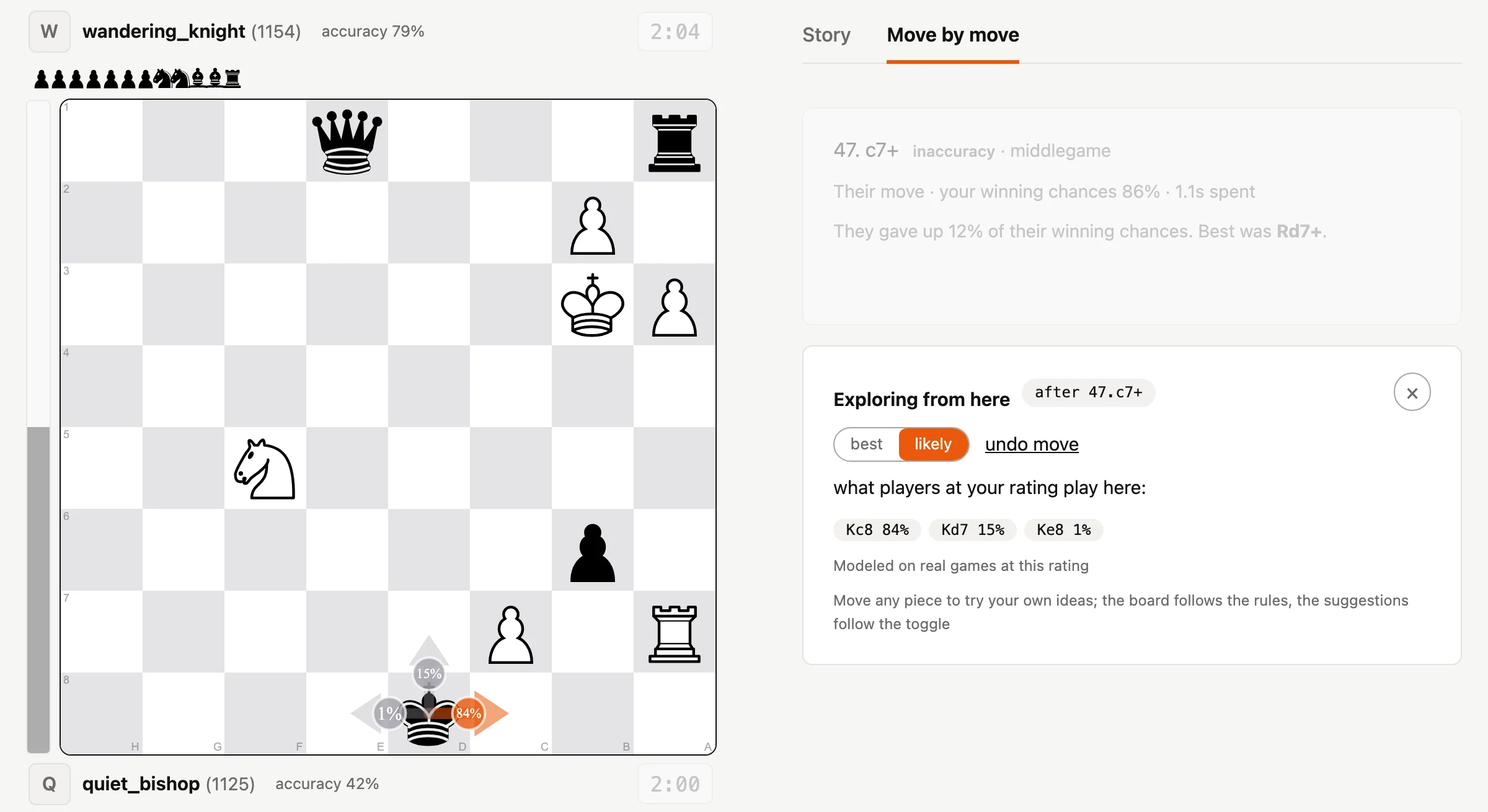
Don't take the coach's word for it
Every position is playable. Move a piece to try your own idea, ask for the engine's best, or switch to likely and see what players at your rating do here, modeled on real games at that level.
In the example, 84% of them play the same king move. The classic mark still says blunder; the coach says why, and what to check next time.
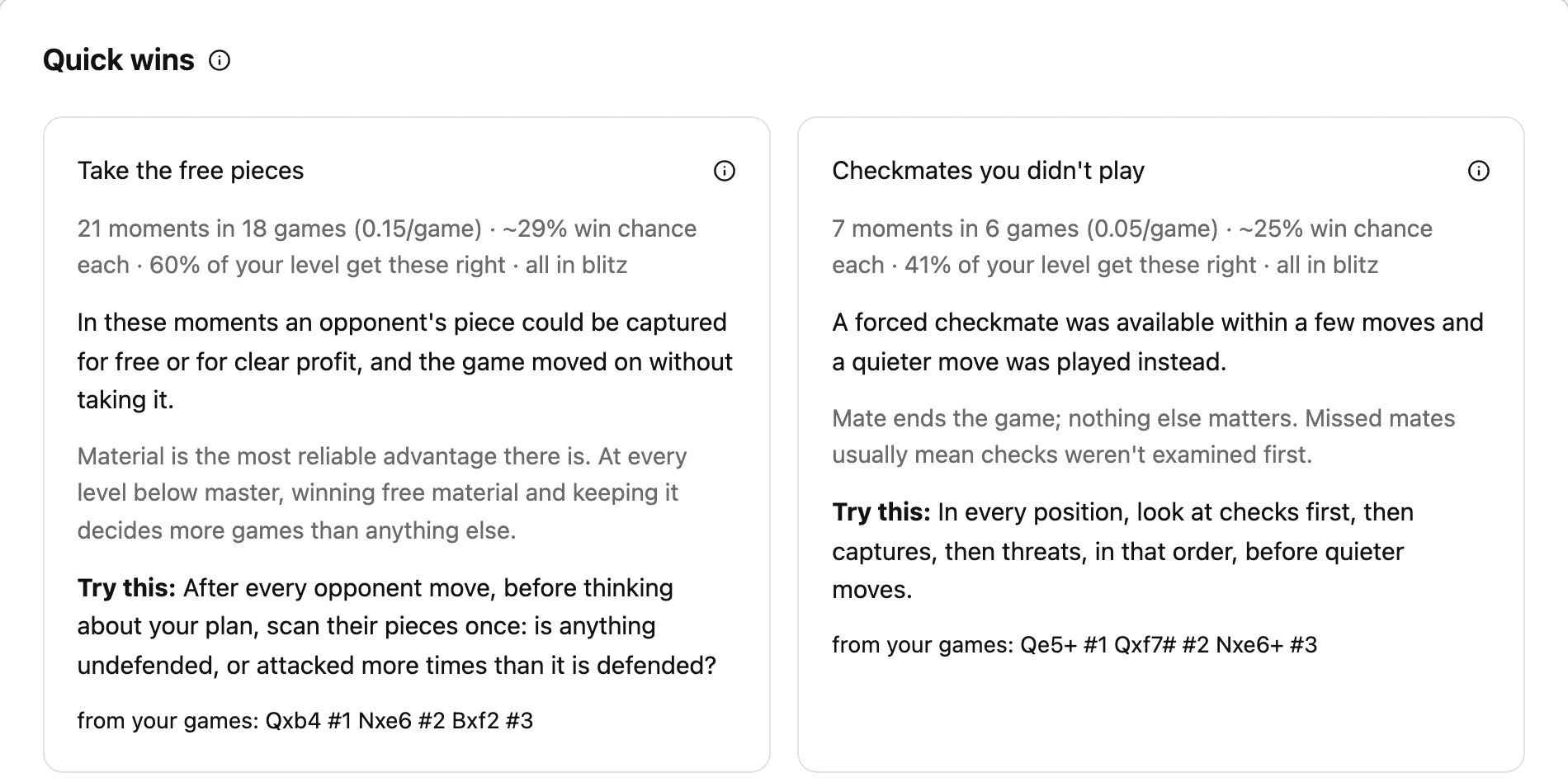
Keep it going with a free account
The review works without one. An account is for the pattern across games: a mistake seen once is a moment; the same one in thirty games is a habit.
- Every game, automatically. New games on chess.com and lichess are imported and analyzed a few times a day. Both accounts make one profile.
- Work on. The two or three things that would win you the most games, ranked by what they cost you and how often players at your level get them right, each with one concrete instruction.
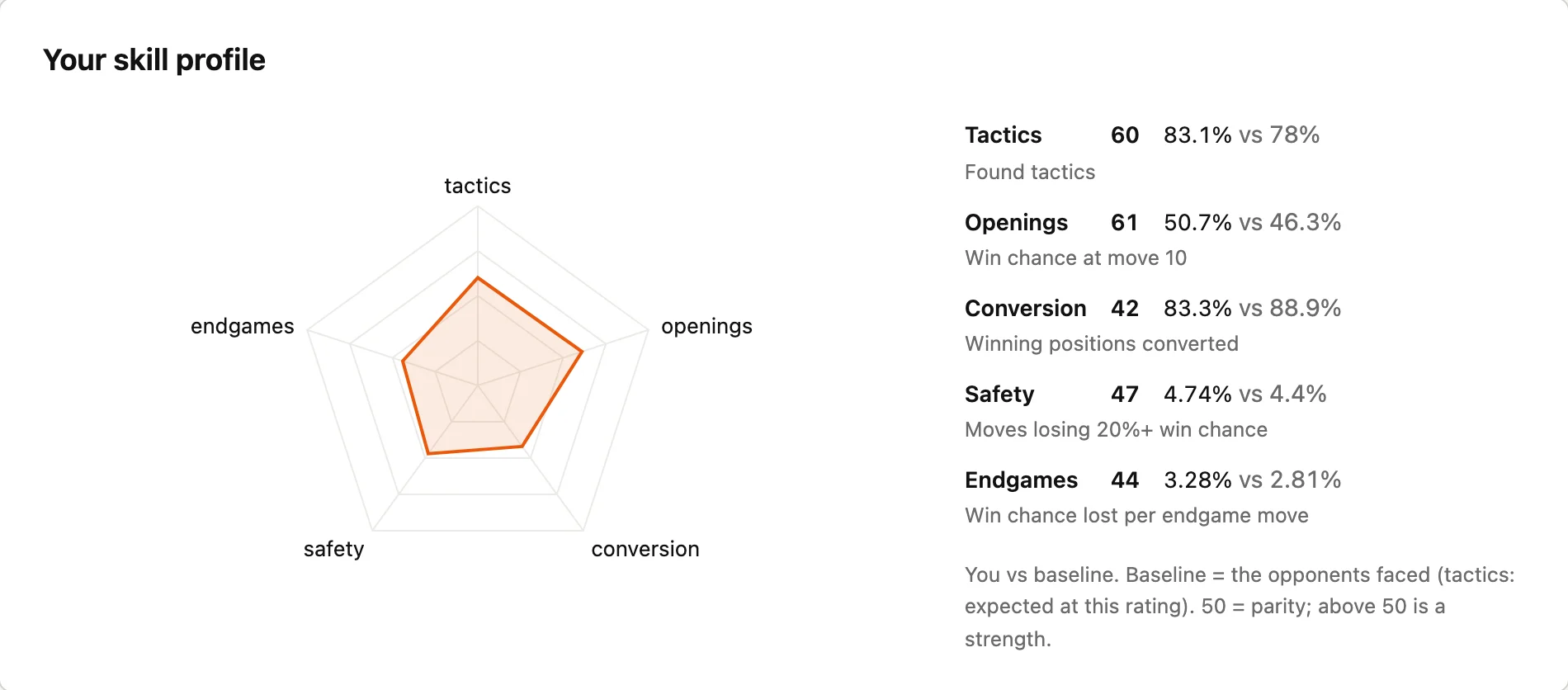
- Insights. A skill profile against the opponents you actually faced, your tactical leaks weighted by how often your level finds them, openings, the clock.
- Training. Puzzles at your measured level, with the tactics you missed in your own games mixed in unlabeled. You find out after solving.
- Ask the coach. A question about any position in a coached game, answered with the same tools and the same checks as the review.
Engine analysis is free. Coached stories and questions come with a monthly allowance.
Questions
- Is it free?
- Yes. A review needs no account and no card: the engine analysis and the coaching are on the house, with a daily budget for visitors so it stays that way. With a free account, analysis of all your games is free and coached stories come with a monthly allowance.
- Do I need to connect my account?
- No. Games on chess.com are public; your username is enough. No password, nothing to install.
- Which games are coached?
- Rapid and blitz. Bullet is listed but not coached: its claims wouldn't be honest at one minute a game.
- What about lichess?
- With an account, lichess games are imported too, and both accounts merge into one profile. Ratings stay per platform. Reviews without an account are chess.com only, for now.
- Does it stay up to date?
- With an account, new games arrive on their own a few times a day. Without one, bookmark your games page and come back after your next game.
- Will it just tell me I played well?
- No. Every claim is checked against the computed analysis before you see it; whatever can't be proven isn't said.
Try it with your last game.
No account, no card. Or create a free account to keep every game.